
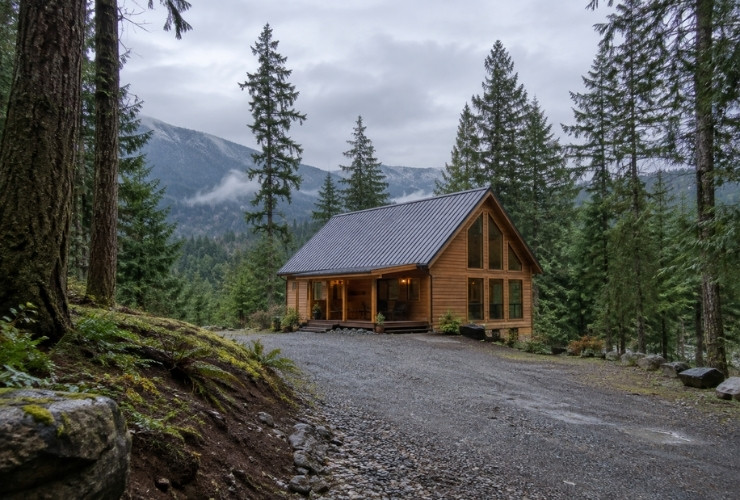
You found the land. Maybe five acres off a forest road in Skamania County, maybe something with a river view in the Idaho panhandle. Now comes the part nobody posts about. Building a cabin in Washington, Oregon or Idaho has much less to do with picking a floor plan and much more to do with proving to a county office that your piece of dirt can legally hold a dwelling, get water, handle sewage, and be reached by a fire engine.
The rules are not the same across the three states. They are sometimes not even the same across two neighboring counties. Here is what actually stops projects, and what to check before you spend real money.
Key Takeaways
- Washington, Oregon and Idaho each enforce a different edition of the residential code right now.
- Oregon land zoned for forest use may not allow a house at all, no matter how many acres you own.
- Every household well in the region falls under a different daily limit depending on the state.
- Wildfire rules have shifted recently, and Oregon repealed its statewide hazard map in 2025.
- Counties want a site plan before they will look at anything else you submit.
- Septic feasibility and legal road access kill more rural projects than budget ever does.
Start With the Land, Not the Cabin Drawings
Almost everyone does this backwards. They buy the parcel, then find out the county will not approve a dwelling on it. Building a cabin legally means the parcel has to clear three separate tests: zoning allows a residence, the soil can take a septic system, and you have a legal way to reach the property year round. Any one of those can be a dead end.
Washington
Washington enforces the 2021 International Residential Code with state amendments, which took effect statewide on March 15, 2024 according to the Washington State Building Code Council.
The next edition is scheduled for 2027, so anyone building a cabin in the next year or two is working under the current book. Counties enforce it locally, and shoreline parcels carry a whole extra permitting layer.
Oregon
Oregon runs its own version. The 2023 Oregon Residential Specialty Code became mandatory for permit applications on April 1, 2024, per the Oregon Building Codes Division.
The bigger issue in Oregon is not the code, it is land use. Roughly eight million private acres sit in forest zones where a house requires a template dwelling approval, and that means counting qualifying neighboring parcels and pre 1993 dwellings inside a 160 acre square. Plenty of beautiful lots simply fail the count.
Idaho
Idaho is the loosest of the three, at least on paper. The state still operates on the 2018 International Residential Code, adopted by statute and listed by the Idaho Division of Occupational and Professional Licenses.
Enforcement is a hybrid. Cities and counties that choose to enforce it do so, and the state handles permitting where nobody local does. Fire districts and health districts still have their own say.
Water Is the Quiet Dealbreaker
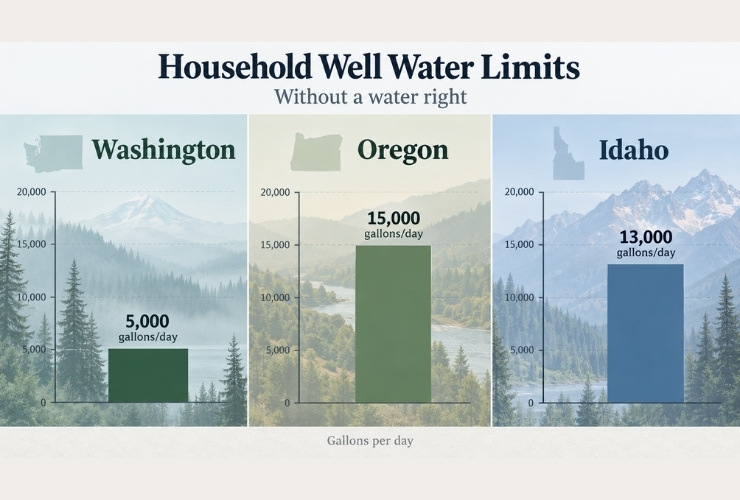
If there is no public water line, your cabin runs on a well, and wells are governed by state water law rather than by the building department. This catches people off guard constantly.
The Washington Department of Ecology allows domestic withdrawals up to 5,000 gallons a day without a permit, but the 2018 Streamflow Restoration law added annual averages of 950 or 3,000 gallons per day in certain watersheds plus a $500 fee collected at building permit time.
Oregon is more generous on volume, allowing 15,000 gallons a day for domestic use under the exemption list published by the Oregon Water Resources Department, with a recording fee once the well is finished.
Idaho sits between them at 13,000 gallons a day, and the Idaho Department of Water Resources updated its guidance in 2026 after the legislature reworked shared well rules.
Ask the seller for the well log before closing. A dry hole on a ridge is an expensive surprise.
What the County Asks For First
View this post on Instagram
Before anyone reviews a structural detail, the planning counter wants to see where the building sits on the parcel. Setbacks, driveway, septic drainfield, reserve area, slopes, streams, easements. Cabin projects stall for weeks because this one document is missing or drawn wrong.
If you do not have a surveyor lined up, a Get a Site Plan service can produce a scaled, county ready drawing from parcel data, which is often enough to get an application accepted and moving.
It is not a substitute for a survey when boundaries are disputed, but for a straightforward rural lot it removes the first bottleneck. Many people building a cabin discover this only after their first rejection letter.
Wildfire Rules Keep Changing
Fire has reshaped rural permitting across the region, and the rules are still moving.
Oregon passed Senate Bill 83 in 2025, repealing the statewide wildfire hazard map created under SB 762 along with the mapped building standards tied to it. Defensible space work is now largely voluntary at state level or set locally.
Washington, meanwhile, has held its wildland urban interface amendments in reserve while statewide hazard mapping is completed.
Practically speaking, your insurer may care more than your county does. Get a quote early. Some carriers will not write a policy at all on certain forest addresses, and a lender will not close without one.
Access and Septic
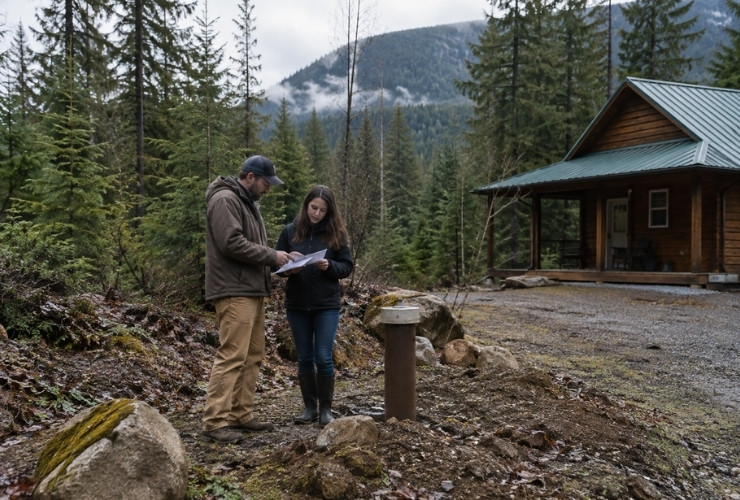
Fire districts usually want a driveway a truck can actually use: width, grade, turnaround, sometimes a bridge rating. Septic approval comes from the local health authority and depends on a percolation test. Test before you buy if you possibly can.
If the land sits near one of the quiet small towns scattered across Washington, you may find a public sewer connection available, which changes the math entirely.
Budget and Timeline
Rural construction runs longer than people expect. Site work, a well, a septic system and a power drop can absorb a large share of the budget before framing starts.
Crews travel further, deliveries cost more, and winter closes some roads. Anyone building a cabin should plan for a season of paperwork ahead of a season of construction.
Resale is worth thinking about too. Cabin demand tracks tourism, and the strongest Pacific Northwest markets for both visitors and property owners tend to hold value better than remote parcels with no rental appeal.
Proximity to trailheads, ski terrain and the kind of outdoor recreation Oregon is known for matters more than square footage.
FAQ
Wrapping Up
The romance of a cabin in the woods is real, and so is the paperwork. The states differ in ways that matter: Washington is code heavy and water restricted, Oregon is land use heavy, Idaho is lighter on paper but still full of local authorities. Check zoning, water and septic before anything else, get your site plan drawn properly, and treat the permit process as the first phase of construction rather than an obstacle to it.
Plenty of people finish the job every year, and the ones who enjoy it are the ones who did the boring research first. If you are still choosing a region, spending a few weekends at family friendly spots around the Pacific Northwest is a cheap way to learn which valley you actually want to wake up in.